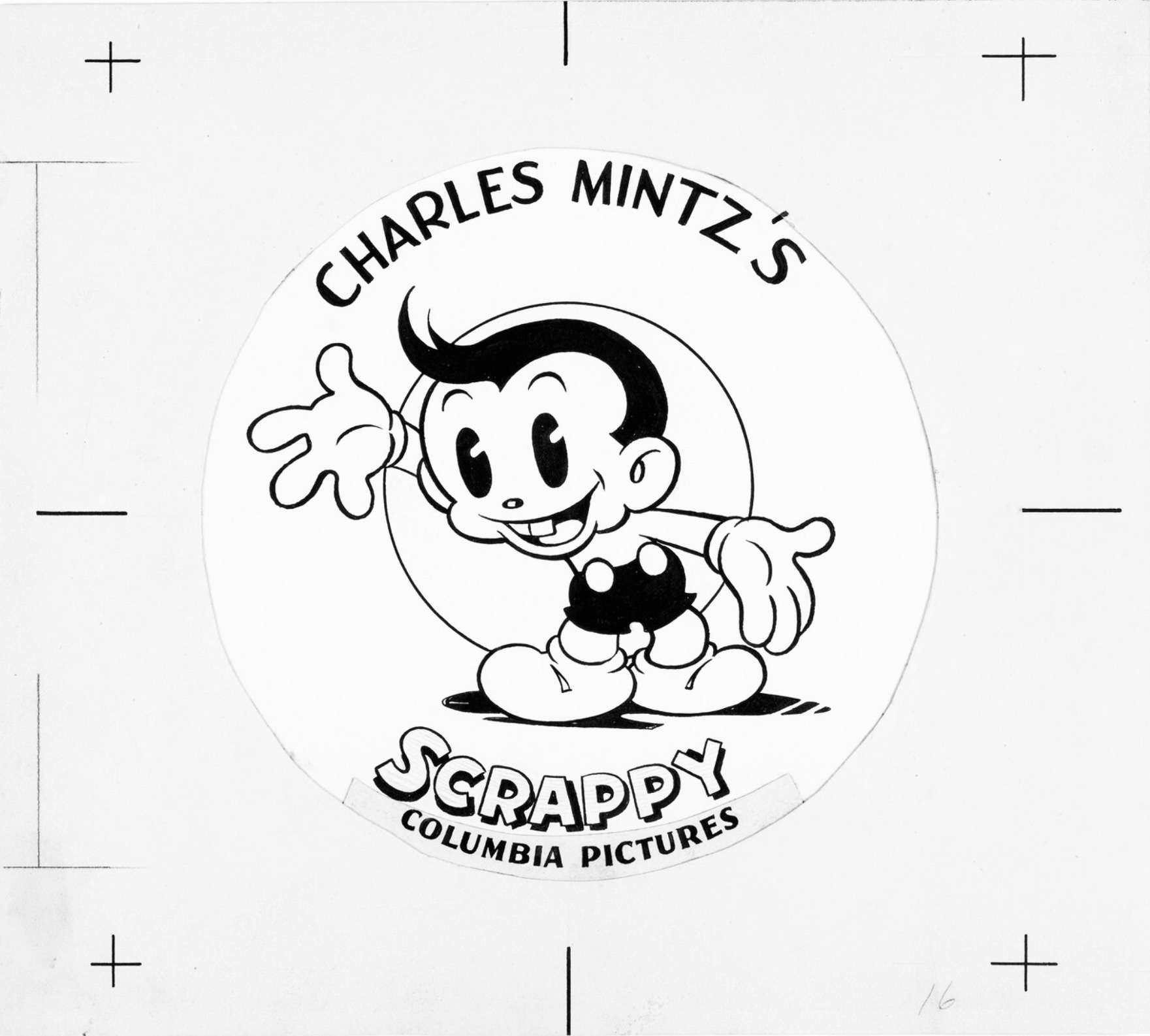
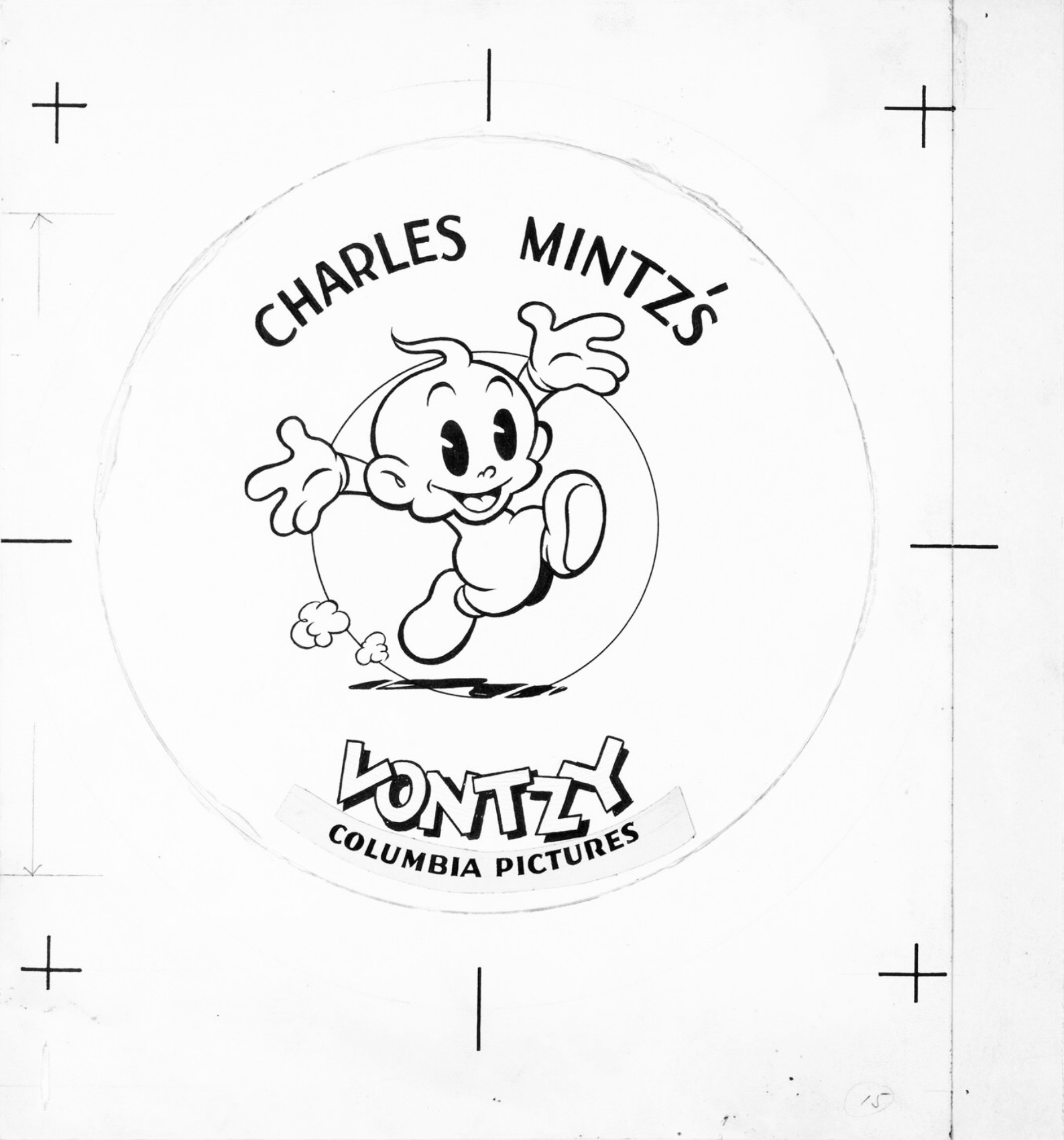
Back in December, I wrote about the original art for the 1930s Yippy pinback button that was part of an excellent set of such buttons given away at movie theaters. Well, Heritage Auctions recently sold two more Scrappy-related pieces of art from the series. And even though they didn’t end up in the Scrappyland collection, I’m pleased to know they still exist and have found a home.
Here’s Scrappy himself—one of the best drawings I’ve seen of him, although I wasn’t aware until now that he has buck teeth.
And here’s Vontzy—better known as Oopy. In fact, this is the only example of him being identified as Vontzy for a merchandising project that I know about off the top of my head, although that was what Dick Huemer originally called him. (Oopy was a more dignified stage name, I guess.)
As far as I know, the set included five Mintz buttons: Scrappy, Vontzy, Yippy, Krazy Kat, and Krazy’s canine girlfriend Kitty. I own the art for Yippy and Kitty, but there were variants of the Yippy button, at least, with different drawings, so one Yippy is still at large. Krazy is also still missing. Here’s hoping they remain extant and in good hands.
If you’re collecting vintage animation art on a budget, specializing in Scrappy will save you money. But not because Mintz art is exceptionally cheap. It’s just that so little of it ever comes up for sale that you’ll only rarely have the opportunity to buy anything at all.
As I’ve mentioned before, I’ve never seen a Scrappy cel reach the market. And some of the Scrappy artwork I have managed to buy—like this, this, and this—is so ephemeral that don’t know how or where it was used. It seems unlikely that the Mintz studio went out of its way to preserve its production art, though I cling to the vanishingly minuscule chance that Columbia still has it all neatly filed away somewhere.
Anyhow, I was pleased to recently add another piece of Scrappy art to my collection—or, more specifically, a piece of Yippy art. Except I’m about to question whether it is, indeed, a depiction of Yippy.
The drawing in question was made for a series of cartoon-character pinback buttons manufactured by a firm called Western Theater in the 1930s. The company did an impressive job of lining up licenses with animation studios and newspaper syndicates, resulting in 50 pins. They included everyone from big names (Betty Boop, Hans, Fritz) to also-rans (Goopy Gear, Marty Monk). Several featured Mintz characters, from both the Scrappy and Krazy Kat series.
Here’s the drawing I bought:
Curiously, Western Theater released its Yippy button in two slightly different designs. One features the art shown above. The other is a pretty crude version of the same image, as if copied by a lesser artist. I don’t know which came first, but I’d hate to think Western Theater started with the button at left and saw fit to replace it with the one at right.
I don’t know who drew the art I bought, but it has a pleasingly Mintzian verve to it, and the odds seem high that it was done at the studio rather than by somebody working directly for Western Theater.
But here’s the strange thing about the drawing: That isn’t the Yippy we know. That Yippy is a small dog, possibly some sort of terrier. Like all Mintz characters, he can look shockingly different from appearance to appearance, but at least you can generally tell who he is.
A few examples from previous Scrappyland posts:
The pooch shown on the pin is entirely different—seemingly a larger, lankier hound dog of some sort. But he does resemble the dog in several 1932 Scrappy cartoons: The Pet Shop, Camping Out, and The Bad Genius, at least. Whether or not that dog is Yippy, he did replace the terrier as a supporting character in the series for a time. And let’s face it, he comes off as a bit of a Pluto knockoff:
Via Animation Resources, here’s a model sheet from Ray Patterson’s collection. Showing Oopy and Scrappy for scale, it seems to establish that the hound is nearly Marmaduke-esque in size, though he was never particularly gigantic in the cartoons. Note that Patterson or some unknown person seems to have used this art as a scratchpad for personal notes.
And then there’s the 1934 Scrappy Big Little Book. Most, if not all, of its illustrations look like they might have existed before the book was conceived. The author, Pat Patterson—who was also credited on two other Columbia-related BLBs—patched together an episodic storyline around that art. Yippy is a major character. But other dogs make fleeting appearances, including a hound bearing a striking resemblance to the one on the pin.
His name is Woofus—not to be confused with the Texas Woofus, which didn’t come along until a couple of years later:
So did Scrappy have two dogs in this book? Nope: Patterson explains that Woofus was “a schnozzle hound owned by Brinker the baker.” There you go: Woofus is a schnozzle hound.
In the Scrappy Big Little Book, Yippy and Woofus are unquestionably different dogs. But the whole purpose of Patterson’s text was to weave existing art into a (semi-)coherent narrative. Revisiting the Scrappy cartoons themselves for this article, I realized that the classic terrier version of Yippy appeared in fewer cartoons than I thought. He came and went, and in between, Scrappy had other dogs who might have been Yippy—and at least one who definitely wasn’t. Bottom line: It’s not all that easy to tell if any given dog is or isn’t Yippy.
1934’s Scrappy’s Dog Show has dogs aplenty, but none of them seem to be Yippy. In 1935’s Scrappy’s Camera Troubles, the terrier Yippy is back, though significantly redesigned. The following year, In My Gondola gives Scrappy … a french bulldog, maybe? Then in 1937’s Canine Capers, Yippy is back in pretty much his original design. A year later, in Scrappy’s Playmates (1938), Scrappy buys a St. Bernard named Butch. 1939’s The Charm Bracelet and 1940’s Practice Made Perfect and The Pooch Parade have a dog who may be Yippy—but if so, he’s been redesigned in the mode of Betty Boop’s regrettably cutesy pal Pudgy.
So I’m not ready to discount a scenario in which Yippy started out as a terrier, was briefly a schnozzle hound (possibly under the alias of Woofus), may have tried life as a french bulldog, went back to being a terrier, and ended his days as a generic cute pup of indeterminate breed. If you have any better theories, please let me know.
Meanwhile, Pluto—who’s about 11 months older than Yippy—began life as a bloodhound named Rover but quickly became his still-recognizable self, and stayed so. Nine decades later, he remains a big business for Disney—okay, a minor one, but surely a heck of a lot more profitable than Yippy was even at his peak. (The Western Theater pin is the only piece of merchandise I know that was solely devoted to Yippy.)
Maybe if Scrappy’s cartoons and merchandising hadn’t been so hap-hazard in terms of consistency, we’d have a Mintzland, Mintz World, Mintz Stores, and Mintz Plus streaming service today. Or possibly not—but it’s fun to think about.
Addendum: Another of Western Theater’s Mintz buttons is noteworthy for naming-related reasons. On the pin for Scrappy’s little brother, he’s called Vontzy rather than Oopy. In a 2013 Scrappyland comment, Mark Kausler said that Dick Huemer himself told him that he intended the character to be known as Vontzy—a reference to Vontz, the Yiddish word for bedbug. Western Theater’s button is the only piece of Scrappy merchandise I’ve seen that uses that name, but if Dick Huemer said Oopy was really Vontzy, that’s all we need to know. He wouldn’t be the first or last movie star who adopted a stage name to conceal his heritage.
Back in 2017, I wrote about Some Scrappy Art I Probably Won’t Be Buying. It consisted of several production drawings that someone was trying to sell on eBay, with a minimum bid of $499 per piece. That was way too rich for even my Scrappy-loving blood.
Fast forward to 2021. Another someone is selling drawings of Scrappy (and other Screen Gems characters) on eBay, clearly from the same stash as the 2017 ones. This time, however, the asking price isn’t just reasonable–it’s dirt cheap for vintage animation art. (In fact, it’s roughly what the sales tax would have been for the 2017 ones.) So I bought some. After all, original Scrappy art of any kind is rare stuff.
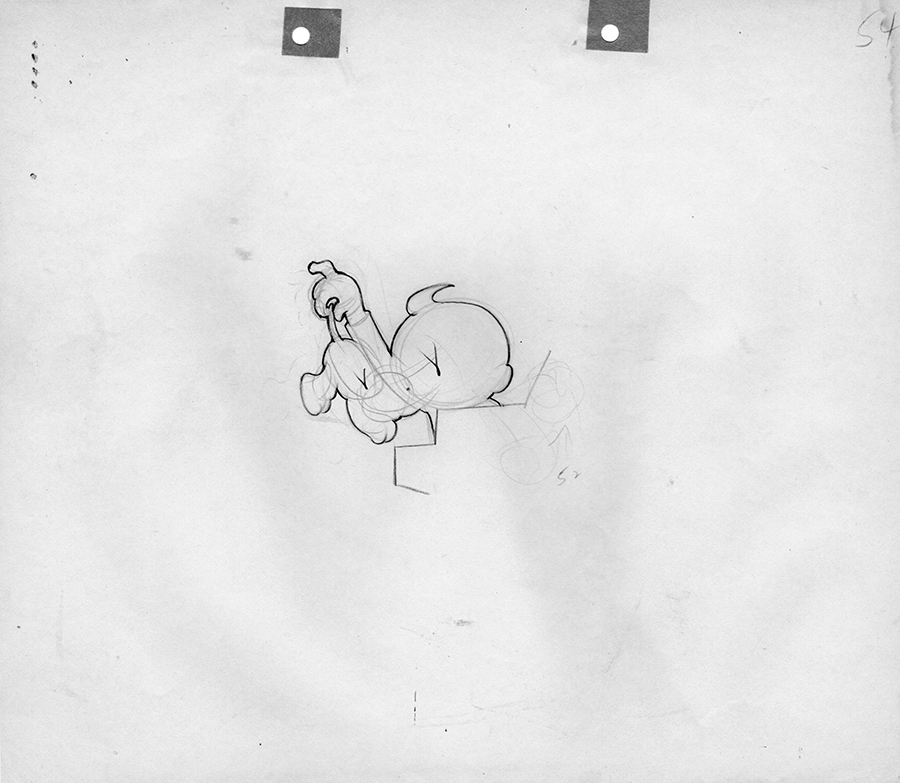
Thanks to Jerry Beck, I now know that all of these drawings are from Practice Makes Perfect, a 1940 Screen Gem that was–depending on how you count–either the seventh or sixth next-to-last Scrappy cartoon. I’m not sure who did this art (or if it’s all by one person), but the credited animators on the short are Harry Love and Peter Falk’s pal Lou Lilly. Herewith, highlights of the art I bought, plus (as best I can tell) the corresponding frames from the finished product.
Scrappy looks like at least two different characters in different portions of this film, but in all cases he’s been redesigned to suit the animation industry’s tastes of the late 1930s, which were considerably more ornate and pseudo-realistic than when the Scrappy series started in 1931. The way Scrappy is drawn with a fastidiously ragged cowlick reminds me of how modern computer animators obsess over details like the pores in Mr. Peabody’s nose.
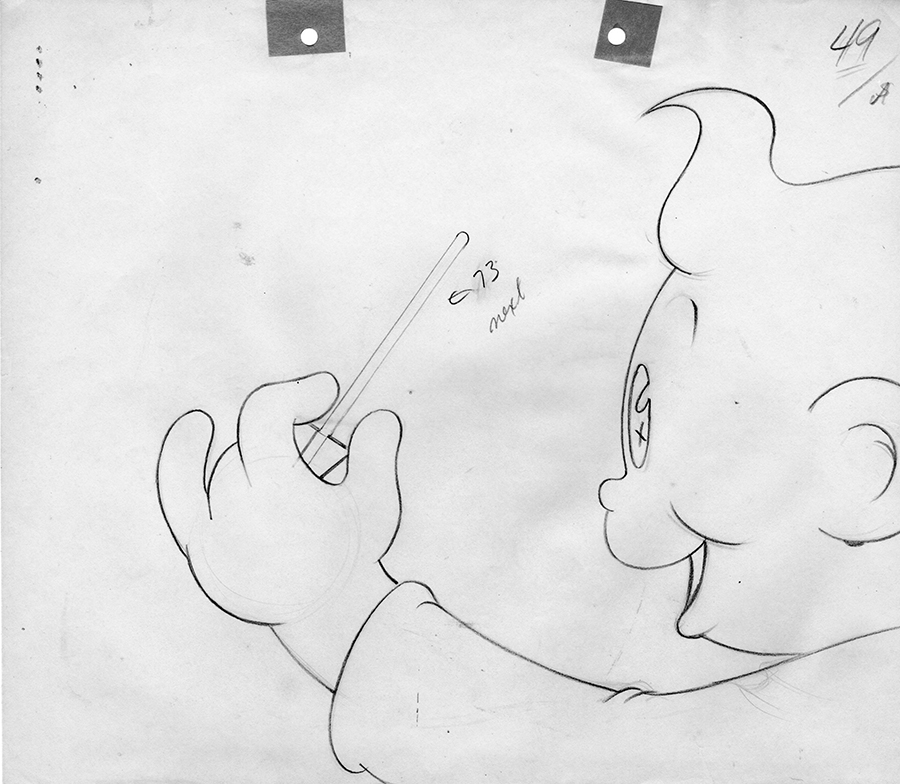
I’m intrigued by the notes on these drawings and wonder what stuff like “UCT BAL” means. Maybe any animators out there reading this can fill me in. Also interesting: The peg holes on all these drawings have been reinforced with bits of heavier paper, seemingly by hand.
Most of the cartoon is devoted to gags involving Oopy interfering with Scrappy’s piano practice. He too has been given a vaguely Fred Moore-esque redesign. This drawing looks like he’s conducting, but he’s actually messing around with Scrappy’s metronome.
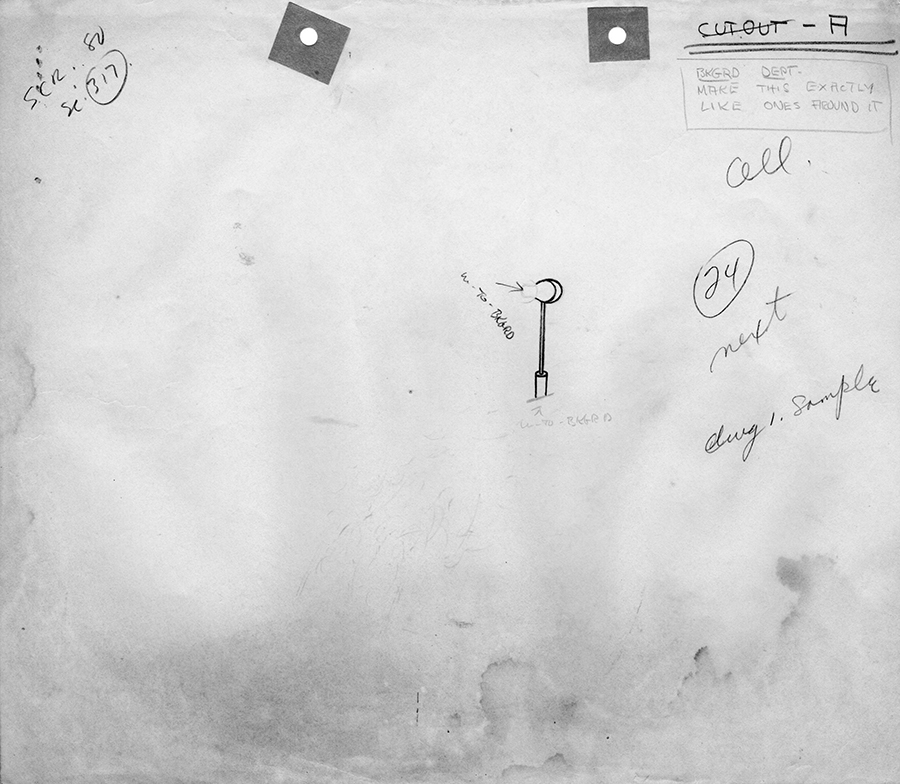
Here’s a hammer from inside the piano (inevitably, Oopy has climbed inside it for the sake of a gag) with a note to the BKGRDDEPT on making it match the other ones. What does “CUT OUT” mean, and is it relevant that it’s crossed out?
Scrappy in close up, also with elaborate hair. Whoever drew this started with some construction lines in red pencil.
Like Mickey Mouse–and most good cartoon characters in general–Scrappy is instantly identifiable in silhouette, or would be if people remembered him. Here he’s holding his pup–is he a redesigned Yippy?–by the tail.
Rather than being Scrappy at his best, Practice Makes Perfect is a bland. unfunny remnant of his decline and fall. Still, I’m glad to own these drawings. It’s fun to think about someone sitting at an animation desk making them at 7000 Santa Monica or 861 Seward (or possibly both: the studio moved in 1940, but I’m not sure exactly when).
Here’s the short in its entirety. Don’t you agree that YouTube’s single greatest contribution to society has probably been making it easier to watch long-unwatched Scrappy cartoons?
Hello from Scrappyland, where it’s been far too long since our last post. (I promise to do better in 2021, which won’t be tough.)
At least this overdue return features something unusually special: a Scrappy image shared with us by my friend Peter Huemer, grandson of Dick Huemer and son of Dr. Richard Huemer. As you can see, it depicts Scrappy and graffiti he has seemingly just painted involving other cartoons. They’re all items that Dick Huemer worked on, and they include:
Mutt and Jeff, whom Huemer began animating for Raoul Barre circa 1916, at the very start of his long career in animation
Koko the Clown, the Out of the Inkwell protagonist animated by Huemer beginning around 1916
Disney’s Mickey and Minnie Mouse, Goofy, and Donald Duck
Fantasia (“Fanny” and “Tasia,” which Huemer cowrote
Also referenced are Walt and Lilly Disney as well as Art Davis and Sid Marcus, Huemer’s Mintz studio collaborators
In short, the art is a playful tribute to Dick Huemer’s career from the beginning through the Fleischer and Mintz periods and well into his Disney days. And that’s all I know about it.
The most obvious mystery: Who drew it? Our candidates must logically begin with Dick Huemer himself, and he seems like a good one. After all, he knew where he’d worked off the top of his head, and he could draw Scrappy. (As shown here, he’s ever so slightly off the early-1930s model as established by Huemer, but that wouldn’t be surprising; by the time he would have drawn this, he would have been rusty.) The style isn’t so obviously Huemer’s that it’s clear it’s his, but at worst, it’s in the same Zip Code.
If it wasn’t Dick who drew it, we can reasonably narrow the field of contenders to people intimately familiar with his career, most likely close friends in the animation industry.
Mystery #2 is when this piece was created. There’s a giant hint in the fact that chronologically, the last Huemer work mentioned is Fantasia. That came out in 1940; in December 1941, Dumbo, which Huemer cowrote with Joe Grant, was released. The fact that Fantasia is there and Dumbo isn’t–not to mention even later Huemer efforts such as the Disneyland TV show–strongly suggests that this art dates from the period when Fantasia had been released or was at least in production but Dumbo remained in the future. Though that’s just a guess; maybe our mystery artist just ran out of space for additional Huemer references..
Also mysterious: The precise events that led to this drawing’s existence. Did Dick do it to amuse himself? Was it for publication? Why does it spotlight Scrappy, who was part of Huemer’s distant past at this point? Dick left Mintz in 1933; the last Scrappy cartoon, The Little Theater, was released in February 1941, ending the series after a long decline. It would seem that the drawing might have been done around the time that Scrappy went away and Screen Gems shed the final vestiges of its Mintz-era origins. Whether that means anything, I can’t say.
It’s possible that answers to some or all of these questions lie in some writing next to Scrappy’s left foot. But it’s far too faint to decipher, even in the version Peter provided, which I lightened for publication here.
Anyhow, it would be fun to know the backstory here, and if you happen to know–or just want to guess–I’d love to hear from you. Even if it remains a mystery, it’s a delightful one–and more evidence that we’re nowhere near done rediscovering our lost Scrappy heritage.
[Update: On Facebook, Friend of Scrappy Mark Newgarden theorizes that Huemer drew this a lot later, for a publication such as Cartoonist Profiles: “The inking matches similar images Huemer created in this era.”]
Want to see some Scrappy cels? You can. Just go to the Academy of Motion Picture Arts and Sciences’ Margaret Herrick Library in LA and look up the “Donald Gledhill Animation Project Collection.” Gledhill was the first husband of Margaret Herrick, who earned the honor of having a library named after her by being the Academy’s first executive director (and, at least possibly, the person who named the Oscar “Oscar”). He tried to put together a how-to book on animation, and while it never reached publication, he assembled a pretty remarkable-sounding collection of 1930s cartoon artwork for it. It includes a total of nine cels from two Scrappy cartoons, Scrappy’s Rodeo and Scrappy’s Side Show.
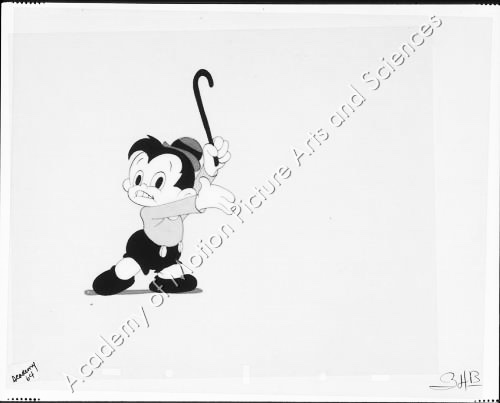
Here’s one from the latter short, with a late-model Scrappy:
I haven’t checked out the Gledhill collection myself, but I should—and so should you, especially if you live closer to it than I do. Those nine cels are the only surviving ones from Scrappy cartoons that I know about.
Over the years, I have managed to assemble a small collection of original Scrappy art. Here’s some of it, and here’s some more. And here’s the original art for the Scrappy pull toy. A little more has escaped my grasp. But I’ve never seen a Scrappy cel for sale.
If I’d been around in the late 1930s, however, I might have been able to pick up a Scrappy cel at a reasonable price. Original cels from Hollywood cartoons were widely sold as a fun and affordable form of art, with the most famous and influential example being the Disney pieces offered by San Francisco’s Courvoisier Galleries. Leon Schlesinger also made cels from his cartoons available, and was nice enough to sign them.
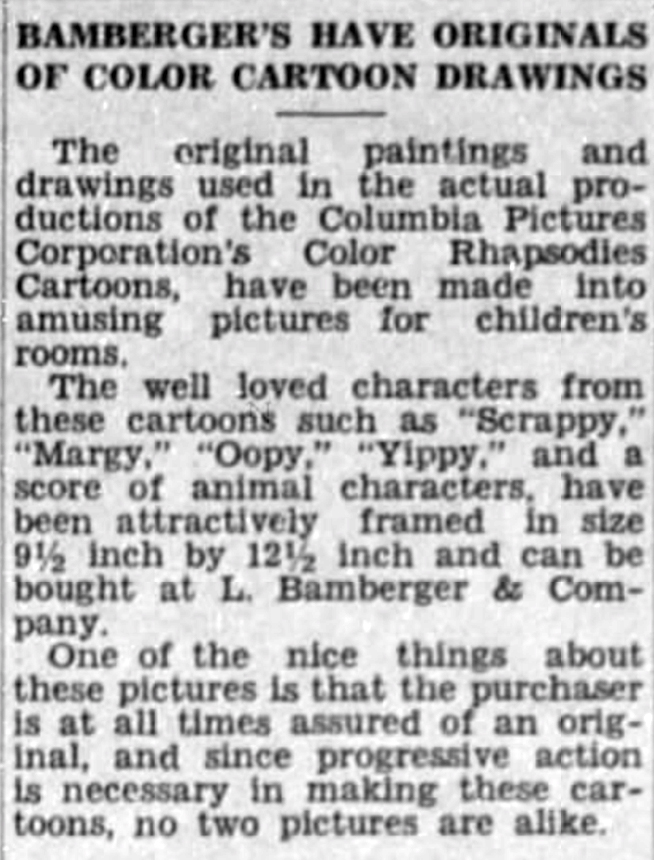
And Charles Mintz seized the opportunity as well. Here’s a December 1937 article from a New Jersey paper:
The Mintz cels may have been intended to dress up children’s rooms, but 80 years later, there are a bunch of examples on eBay at prices up to $1200. Here are three of them, all in nice shape:
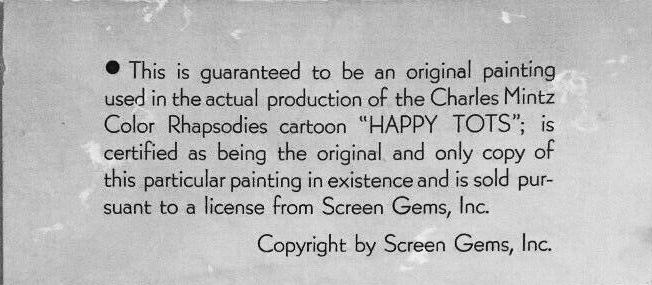
And here’s the label from one of these cel’s backsides explaining its provenance:
These cels also have stickers on their backs from Cleveland’s Guenther Galleries; presumably it and Bamberger’s, the department store mentioned in the newspaper article participated in an art sale program that may well have involved other merchants around the country.
All of these Mintz cels on eBay are from Happy Tots. Which—you probably already know this—was not a Scrappy cartoon. The Gledhill collection at the Margaret Herrick Library also has some Happy Tots cels, suggesting that it was a cartoon whose cels Mintz dispensed with particularly freely.
So which Scrappy cartoons was that newspaper article referring to? That is a toughie. The newspaper piece specifies that the cels were from Color Rhapsodies, and that some featured Scrappy, Margy, Oopy, and Yippy. But Scrappy only appeared in four Color Rhapsodies. The last of them, Merry Mutineers, was released in August 1936, well before the newspaper announcement. All his other cartoons were in black and white.
It’s certainly possible that the newspaper story’s wording was sloppy and that the Scrappy cels you could buy were in black and white. Many of the surviving cels from the Schlesinger studio’s sales program are from black and white cartoons, so there’s no reason to assume that Mintz would have rejected the idea of selling b&w cels out of hand. Especially since Scrappy, his most recognizable property, was mostly monochromatic.
Still, the fact that it’s cels from Happy Tots that are available in relative abundance makes me uncertain just how many pieces of Mintz art made it to the public. I’m not assuming that any Scrappy cels were sold, let alone that they survived until the present day. But it’s nice to think they may be out there somewhere, perhaps in the possession of some late-1930s child who once had one up in his or her bedroom—and was smart enough to hold onto it.
Over on eBay, someone is selling a few production drawings of Scrappy and Oopy, as well as other art from 1930s Columbia cartoons. The merchant says that they came from the collection of the grandson of a Columbia artist, and has set rather high minimum bids: If you were to snag all of these, it would cost you at least $2,495. Scrappy art is exceedingly rare, but that seems overly optimistic for these particular examples.
Still, it’s nice to see them out there, and I have borrowed the auction images for this post. They’re yet more evidence that nobody worked very hard to give Scrappy a consistent look from short to short or, sometimes, screen to scene. (My favorite is the Oopy close-up at the bottom.)
These are from later-ish Scrappy cartoons, but I’m not sure offhand which ones. If you know, please tell us.
If you aspire to collect Scrappy original art, you must be a patient soul: It comes along very, very rarely. But I’ve added another item to my collection. And–this being Scrappy–it’s another wonderfully mysterious work.
The piece is titled “Scrappy in the Race,” and was done for a piece of Scrappy merchandise–which I know for sure because it’s marked “Scrappy and Oopie merchandising” on the backside. I don’t know where it appeared. Actually, I don’t even know if it appeared, especially since it’s in pencil and not all that tight. It could have been intended for almost anything, from a book illustration to a jigsaw puzzle.
It seems obvious that this art, unlike some associated with Scrappy products, was done by a Mintz staffer. Is it by Dick Huemer? It certainly feels like it might be–and Oopy’s glee and expressive hands strike me as Huemeresque–but I’m not sure. I asked Dick’s son, Dr. Richard Huemer, and he wasn’t sure either. Like me, he concluded that it would be easier to tell if it was inked. (His father had a particularly elegant, distinctive inking style.)
I do have a Scrappy original that is by Dick Huemer, and other than the fact it’s also on Strathmore board, it doesn’t particularly resemble this one. It doesn’t feel like they’re from the same project. Probably.
I’d love to think that whatever piece of merchandise this was done for is out there somewhere, available for rediscovery. If it isn’t, I’ll survive–you don’t collect Scrappy art unless you’re willing to accept that some enigmas were never meant to be solved.
Back in the 1930s, a company on Fifth Ave. in New York called Peterson Manufacturing licensed the rights to issue Scrappy art supplies. The packaging it created for these products has some of the nicest art I’ve seen in the whole world of Scrappyana.
I’ve shared these two images before:
And here’s another one, courtesy of Friend of Scrappy Jerry Beck–who recently spotted it in Leonard Maltin’s collection. It shows Scrappy sculpting a life-sized statue of his brother Oopy.
These three boxes were clearly illustrated by the same person. I’ve never seen any other Scrappy art that was clearly by that artist.
Did Peterson get this art from the Mintz Studio, or did it company whip it up on its own, as manufacturers of Scrappy products often seemed to do? I don’t know. Either way, these drawings of Scrappy, Margy, and Oopy have considerable verve and charm.
I’d never seen Peterson’s Scrappy Modeling Clay box until Jerry brought it to my attention–and I’d like to think there’s more Scrappy art out there by this artist waiting to be discovered.
Back in the 1930s, a company called Western Theater issued pins of cartoon characters, which I presume were intended as movie-theater giveaways. It did an impressive job of lining up licenses, producing pins featuring everybody from Harold Teen to Betty Boop to Oswald the Rabbit. And — as you’ve already surmised — the Mintz characters.
Here are Scrappy, two slight Yippy variants, Vontzy and, for good measure, Krazy Kat.
These being Mintz characters, it’s not surprising that the approach to naming is…well, surprising. We all know that Scrappy’s dog is Yippy, but he’s usually a pint-sized, terrier-like pooch. Except when he’s a big old hound dog, as he is here. (This pet was also known to go by the name of Woofus.)
Scrappy’s brother Vontzy, meanwhile, was generally known as Oopy — in fact, this is the only piece of merchandise I know about which calls him Vontzy. Eighty years later, this is still a point of confusion: The Big Cartoon Database thinks that the Scrappy series involved bullies named Vonsey and Oopie.
Unlike a lot of Scrappy merchandising art, these pieces were done with care, apparently by a Mintz artist. Here’s the original art for the only Mintz-related Western Theater pin back I know of that’s not shown above:
That’s Krazy Kat’s girlfriend, Kitty Kat, who seems to be a dog. I hope that George Herriman didn’t know about this — or, if he did, that he was amused rather than outraged.
Say, I forgot I have another drawing of Zadoc. Actually, it’s a looser rendition of the same drawing–and it’s on a page with some sketches of Yippy, definitively establishing Zadoc as a denizen of the Scrappyverse. As for the gruff kid in the cap, he looks like the bully from Sunday Clothes. A cartoon which Zadoc doesn’t appear in.
I’ll let you know if I come any closer to figuring out just who Zadoc was.