As you know if you’re a Scrappyland regular, the Hollywood newspaper Film Dailycovered Scrappy merchandise with admirable thoroughness. But here’s a discovery, recently made by Friend of Scrappy Andrew Leal: Scrappy endorsed the paper, in the following comic strip published on November 15, 1934. (Click it for a larger version.)
As is often the case with Scrappy art, this seems to have been drawn by a non-Mintz artist — I use the word loosely — relying on swipes from stock poses.
On the same page — this may or may not be a weird coincidence — the Daily ran a short news item on the debut of Scrappy briefcases and schoolbags, predicting their success. (I take it that the “Columbia Pictures” byline may mean that the story was submitted by the studio.)
Come to think of it, it’s no surprise that Scrappy liked to read this publication: Who wouldn’t want to read a publication in which one’s name popped up so regularly?
Let’s continue our exploration of the bizarre world of Shorty Shortcake — the Wonder and Wonderworld comics character who is very nearly Scrappy, but not quite so. Starting with Wonderworld #5, each Shorty story started with a splash panel — often an elaborate one. Taken as a group, they summarize the storyline, which started being distinctly un-Mintzlike and grew only more so in subsequent issues. They also show that Jerry Williams, the feature’s cartoonist, utterly changed his style every few issues. Gifted man.
Here are all the Shorty splashes I’ve found. They’re from Wonderworld #5-#20, and a few are missing.
This uncredited article from the December 27, 1932 issue of something called The Hollywood Filmograph is weird. Was there a Scrappy short with caricatures of movie stars acting like Krazy Kats, whatever that means? Is the piece joking when it calls Charles Mintz a directing genius, considering that neither of the words in that description is accurate?
It’s so odd that I don’t know whether to trust any of the facts and figures in it which I don’t otherwise know to be true. But for the record, here it is.
For years now, we’ve known that Will Eisner and Jerry Iger tried to syndicate a newspaper comic strip about Scrappy in 1937. There doesn’t seem to be any evidence that any newspapers in the U.S. ran it, but it made its way to both France and Australia.
And now, thanks to Friend of Scrappy Mark Newgarden, we know that the Eisner/Iger Scrappy was published in this country. In fact, it appeared in a rather famous comic book. It’s just that it was stripped of all obvious evidence that it was about Scrappy, and I’m not sure if anyone has noticed the connection until now — at least in the last seventy years or so.
The comic book in question was called Wonder Comics for its first two issues, then became Wonderworld Comics. It was published by Victor Fox, the early comics magnate who commissioned scads of work from Eisner and Iger. It’s rather well known that Fox had Eisner create a superhero called Wonder Man for Wonder Comics #1, cover-dated May 1939 — the first Superman imitation, and so blatant a knockoff that National Periodical Publications successfully sued him off the newsstand after one issue.
Wonder Man wasn’t Wonder‘s only blatant knockoff. Actually, almost everything in it seemed to be derived from already-popular material. And twenty issues of that comic and its successor, Wonderworld, included a feature called Shorty Shortcake about this little kid who had a girlfriend named Suzy and a dog named Snippy.
Shorty looked exactly like Scrappy, except that he had parted hair instead of a cowlick, pupiled eyes instead of pie-slice ones and suspenders instead of Mickey Mouse-style trouser buttons. Suzy looked exactly like Margy, except that she was a brunette rather than a redhead and had pupiled eyes. And Snippy looked exactly like Yippy, period.
We don’t know the precise circumstances of how Scrappy came to be Shorty, but the gist of the situation is obvious: Eisner and Iger wanted to reuse Scrappy comics they’d produced, and wouldn’t or couldn’t secure the rights to publish them as such. So they renamed the characters and retouched the strips. Rather sloppily so — here’s a panel from the first “Shorty” story (left) in which Suzy calls him Scrappy. (The original version is on the right, borrowed from Ken Quattro’s excellent Comics Detective site.)
I suppose that it’s just barely conceivable that Columbia knew about Shorty and was O.K. with him. But if Eisner/Iger and/or Fox reused this material without the studio’s permission, it would have been a risky gambit. At the very least, you’d think that there must have been late 1930s kids who watched Scrappy cartoons and read Shorty comics and wondered what the deal was.
Then again, Scrappy’s film career was already winding down: Only a handful of Scrappy cartoons were released after Shorty Shortcake’s debut, and some of them barely qualified as Scrappy cartoons. The little guy was already damaged goods.
More damning evidence that Shorty Shortcake is Scrappy, in case anyone needs it: The top level is from a Scrappy story published in France, and the bottom one is from a Shorty story. Note the extensive modifications to the art, such as the different cap on the left-hand thug in the first panel. Of course, both of these versions have been modified from the original English-language Scrappy version, so I’m not sure what was changed when.
All Shorty Shortcake stories were signed by “Jerry Williams” — a name which was, like most or all of the bylines in Wonder and Wonderworld, a pseudonym. Who for? Well, the comic-book reference works which have noticed that the feature existed at all credit it to Jerry Iger himself and to longtime Eisner associate Klaus Nordling. But you only have to skim the stories — which you can do for free at the wonderful Comic Book Plus site — to see that far more than two different cartoonists worked on the feature at various times.
More on the artists behind Shorty Shortcake, and lots more, in future posts. For now, courtesy of Comic Book Plus, here’s the first Shorty Shortcake story, from a microfiche copy of Wonder Comics #1. You can click on the first page and then step through larger images if you like.
As you’ll see, the plot involves Scrap–er, Shorty getting involved with smugglers in Mexico. As un-Mintzlike as that sounds, future Shorty Shortcake stories only veered further and further from their inspiration, as we’ll discuss soon.
I don’t claim to be psychic. But then again, consider this evidence: Earlier this month, I flew to San Diego for Comic-Con and entered the cavernous, merchandise-packed convention center. And after just ten minutes of browsing, I’d found a new and unknown Scrappy item to add to Scrappyland’s archives.
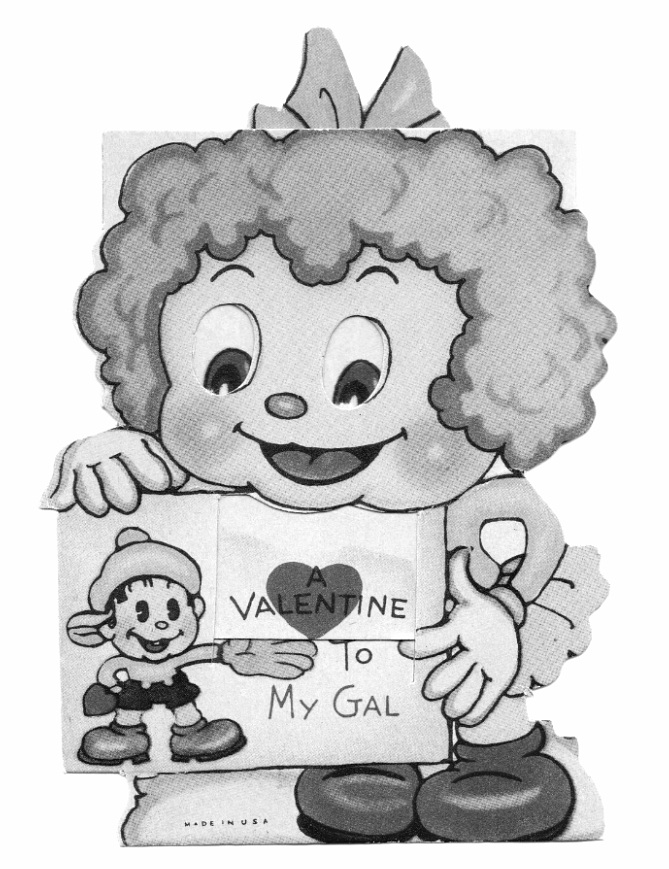
By “new and unknown” I mean, of course, old and unknown. The lost treasure in question — which cost me a very reasonable $10 — is this valentine card, which depicts Margy brandishing a valentine given to her by Scrappy. Pull her bow up, and her eyes move and a new message is revealed: “To ‘Letter’ Know She’s a Swell Pal”
(Note that the artist, who I’m guessing worked for a card company rather than the Mintz studio, had to take artistic license to make the idea work. He’s replaced Margy’s pie-slice eyes with ones with brown pupils, irises, whites…the whole deal.)
The card makes no reference to Scrappy or Margy’s names, nor does it carry a Mintz or Columbia copyright. That might be evidence that the characters, back in the 1930s, were so famous that any kid would know them on sight. But your average 21st-century memorabilia seller has no idea who Scrappy is, which means that if there are more cards out there — and I’ll bet there are — they’re not going to be a cakewalk to track down.
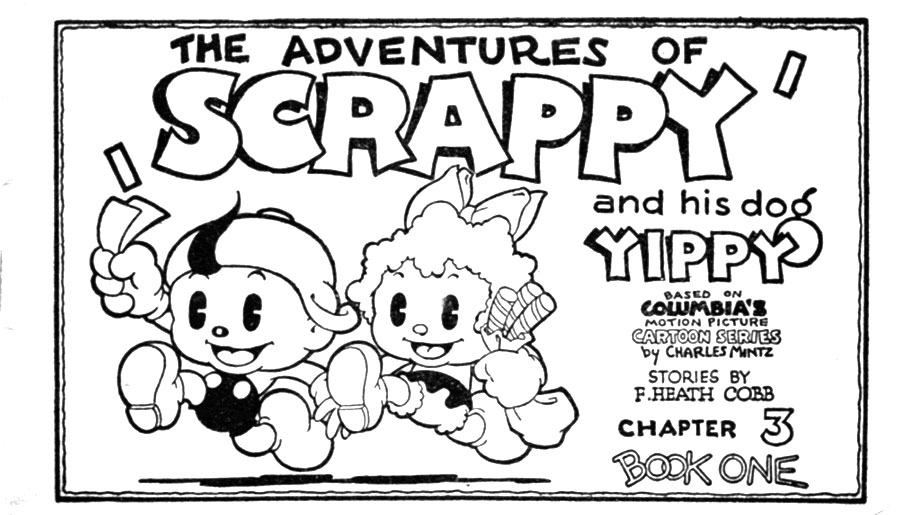
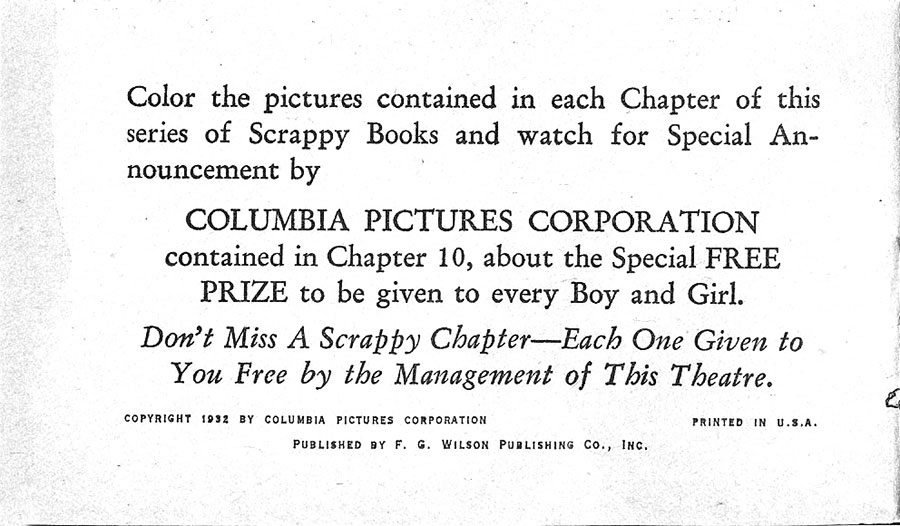
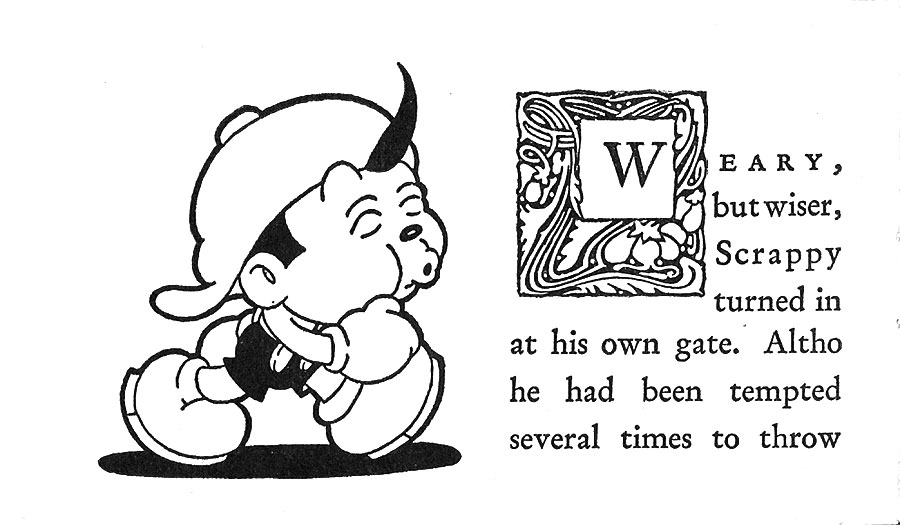
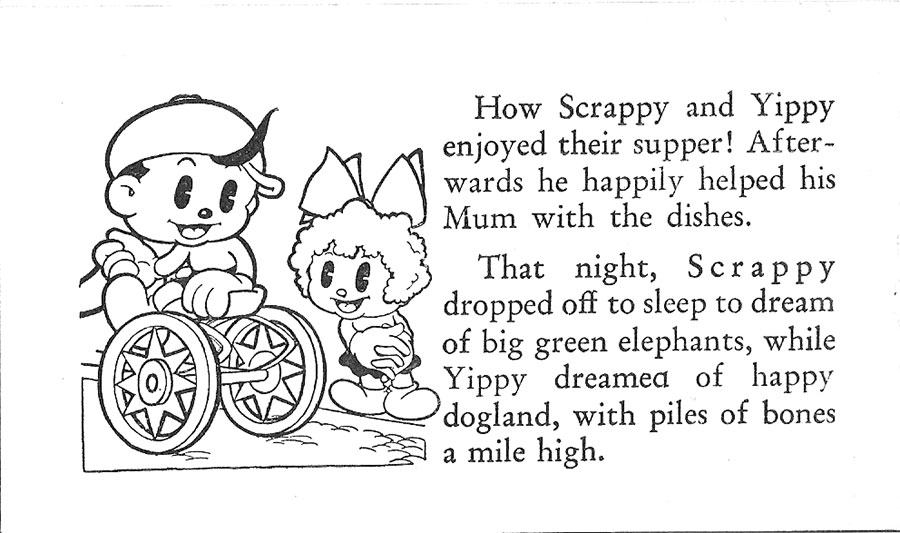
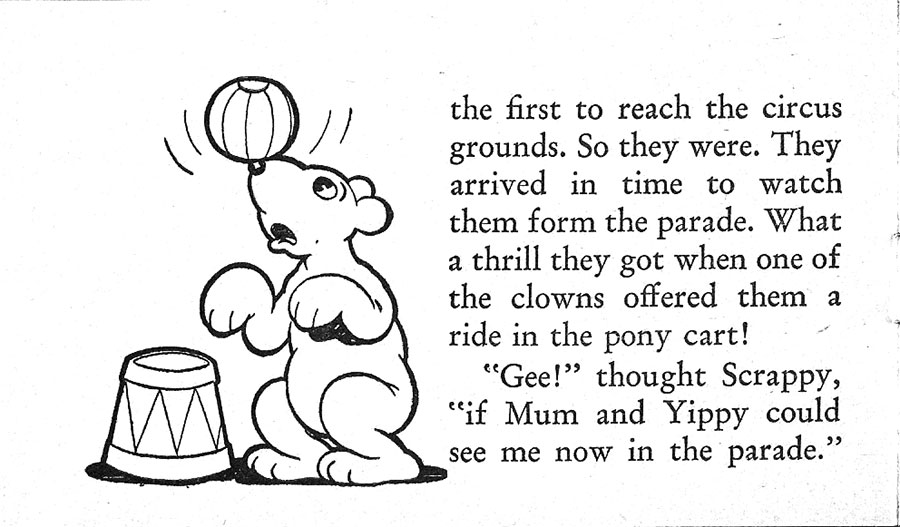
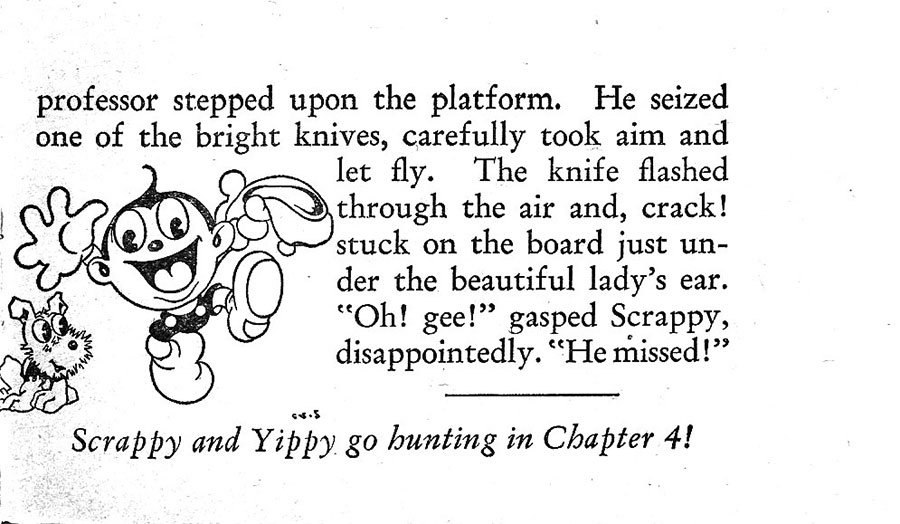
Some of the Scrappy fans who went to the movies in 1932 got to take Scrappy home with him — in the form of The Adventures of Scrappy and His Dog Yippy, a serialized story which appears to have been told across at least ten little booklets.
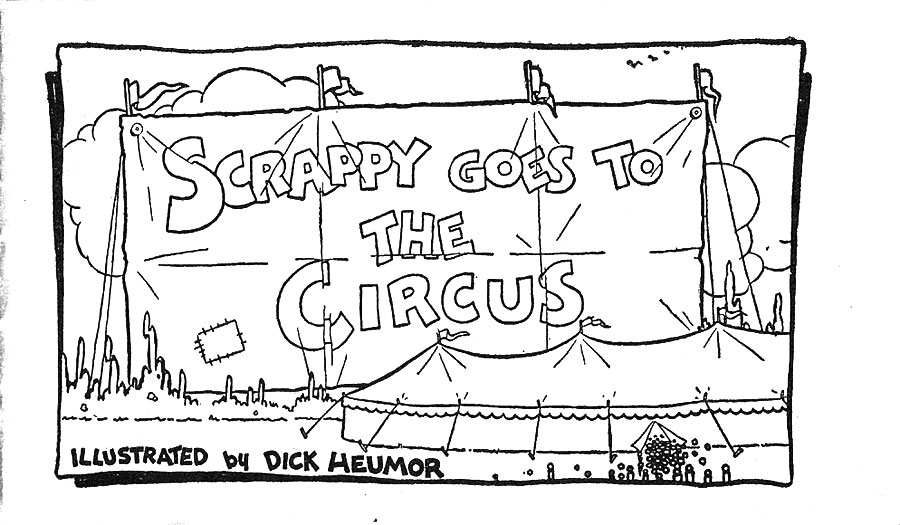
The booklets — at least the ones I’ve seen — have drawings by Dick Heumor, who is actually Dick Huemer experimenting with a new spelling for his name. They seem, however, to be mostly or entirely stock art.
Here’s chapter three, the earliest one I own, in which Scrappy and Margie (aka Margy) go to the circus; as it begins, Scrappy has just finished fishing. (I’m guessing that chapter two was titled “Scrappy Goes Fishing,” and now I’m wondering if there’s any chance that I own a piece of art from it.) I’d love to own the whole set someday — especially since chapter ten apparently reveals an exciting prize that was to given to every boy and girl. If it turned out it wasn’t Scrappy-related, it would be terribly disappointing.
I tend to assume that nobody who isn’t an obsessive cartoon fan knows Scrappy. That isn’t quite true, though — if you’re old enough, you may have watched Scrappy on TV, back when the airwaves practically buckled under the weight of vast quantities of old black-and-white theatrical cartoons.
This fascinating article from Billboard, from December 4, 1954, reports on the deals that brought Scrappy — and Krazy Kat, Oswald the Rabbit, Pooch the Pup, and others — to television. As the story explains, the medium was starved for animated content, and still reliant largely on silent cartoons starring Felix the Cat and others. Scrappy cartoons, despite being up to twenty-three years old, were fresh and exciting by the era’s standards.
Hygo, the company mentioned as distributing the Scrappy cartoons to television, owned Samba Pictures, the company whose name pops up in the opening titles of most of the prints of Scrappy cartoons I’ve ever seen (such as this one). I believe that Samba may have technically owned the television rights to the shorts, but Hygo did the actual distributing.
The article also says that fifty Mintz cartoons were rejected for poor print quality or objectionable content. I wonder which ones they were, and what you had to do to be too offensive for 1950s TV?
It’s been far too long since we watched a Scrappy cartoon together. And what a Scrappy cartoon to watch: The Flop House (1932), the one which Paul Etcheverry and Will Friedwald’s pioneering article on Scrappy rightly called “perhaps the ultimate depression-era cartoon.”
The flop house in question is operated by Scrappy, and all the customers are down-on-their-luck animals — except for Scrappy’s brother Oopy. This is the Scrappyverse, so the premise is no odder than those of numerous other cartoons in the series. I’ve watched this probably fifty times and never get tired of it — but if you’re about to be entertained by it for the first time, I’m jealous.
Among Scrappy’s many notable achievements: he starred in not one but two unsuccessful newspaper comics. I’ll write about one of them — the one with the Will Eisner connection — another time. This post is about Scrappy Sayings, which ran in papers as early as 1935. Years ago, comics scholar D.D. Degg alerted me to its availability in an online archive of a paper called the Grosse Pointe (Mich.) Review. The paper ran it erratically — sometimes every week, sometimes two panels in one week, often not at all — in 1936 and 1937.
Scrappy Sayings is weird — it involves Scrappy, so it would be weird if it wasn’t weird. How to describe it? It’s a little like Love Is, if Love Is starred a fully-dressed Scrappy and Margy, used terrible jokes which made no sense in a feature about small children, and took place during the depression. And was drawn by someone who didn’t know how to draw Scrappy. (Anytime he looks like himself, he’s almost certainly a swipe.)
The panel was syndicated by something called the Columbia Feature Service, which was apparently an arm of Columbia Pictures, since all its features involved the studio’s films. I assume that nobody ever looked at Scrappy Sayings as anything other than promotion for Scrappy cartoons. (It sure wasn’t Floyd Gottfredson’s Mickey Mouse.)
Here are all the examples I could find — including one fragment — in the order the Grosse Pointe Review ran them, although they don’t seem to have published them in chronological order, nor to have run all of them. But even this poorly-reproduced smattering is probably the most Scrappy Sayings ever published in one place at one time.
As we’ve seen before, the Film Daily frequently reported on Columbia’s untiring efforts to merchandise Scrappy. It published several stories on the ultimate Scrappy promotion, the Scrappy Puppet Theater. In this one, from September 16, 1936, Columbia’s campaign starts out sounding ambitious — and by the end, with its mention of “armies of children” whose entire existence is defined by their consumption of a never-ending Scrappy promotion, it sounds downright terrifying.