I don’t think we’ve ever run this delightful 1973 photo of Dick Huemer exuberantly brandishing his “Mousecar” award from Disney in February 1973, alongside his fellow studio veterans Jack Cutting, Bill Cottrell, and Les Clark.
This is a treat. Back in 2012, I wrote about the eight-part oral history of Dick Huemer that Joe Adamson conducted in 1968 and 1969 as part of a UCLA project. Revisiting my post just now, I discovered that the link to the transcript no longer worked. I’ve replaced it with one to an Internet Archive copy that’s likely to remain operative indefinitely. While I was hunting that down, I discovered that UCLA has put up the audio of Joe’s 10 hours of Huemer interviews. (Note: They didn’t play on my iPad or on Safari on my Mac—I had to use Chrome.)
I’m not sure if I’ve ever heard Huemer’s voice before. Now I can feast on it, in a conversation with Joe that lasted, on and off, for more than a year. One of the reasons it’s so pleasant to hear him speak is that it reminds me of what it was like to talk with his son, Dr. Richard Huemer, whom I miss.
Joe and Dick’s discussion covers Scrappy and other Mintzana, but also the rest of Dick’s long career, both before and after the period covered on this website. It’s an essential piece of animation history, and we should be grateful to Joe for instigating it almost 60 years ago and to UCLA for making it available today.
With time, I hope more vintage audio of interviews with signficant figures from the golden age will become accessible. I deeply regret not saving the tapes of interviews I did for Animato in the 1980s and early 1990s, and have more recently become meticulous about preserving recordings of interviews I conduct. Sadly, almost none of them have anything to do with cartoons. And the opportunity to talk to people like Dick is gone, which is why I’m so glad we can listen in on what Joe heard when he got the opportunity.
My 2012 post still links to a scan of the original typed transcript of the oral history. UCLA has also made a modern, more legible PDF transcript available. Here it is.
A most happy 2026 to each and every one of you. (Here at Scrappyland, happiness is never in short supply, regardless of how things are going elsewhere in the world.) I apologize for the lack of activity here in recent months. As usual, it’s not because of any shortage of material to share, so stay tuned.
Tommy Storslee and his wife are eBay sellers who like to pick up interesting old items at garage sales and estate sales. In certain cases, instead of selling them, they simply try to make sure that they get to a good home. I’m delighted to say that when they found a battered 1930s envelope containing 52 printed drawings of Scrappy and his pals, the good home they chose was with me.
The 52 drawings add up to a year-long course in drawing cartoons. Or at least that’s how Columbia pitched them. They came in this envelope, which curiously doesn’t mention Scrappy, though the New York address given is the one from which the firm’s legendary Scrappy Franchise Department operated.
I’ve written before about Columbia’s efforts to publicize Scrappy by convincing schools and other kid-oriented organizations to conduct drawing lessons involving the character. Indeed, one of Scrappyland’s first posts featured a 1936 letter to a camp director about this program. I had a few of the drawings the studio sent out. But the envelope Tommy sent me contained all 52—an entire year’s curriculum.
It didn’t include a cover letter or any material that was explicitly instructional in nature, but perhaps they got lost at some point in the past 90 years or so. (Columbia published a booklet called “How to Make a Cartoon by ‘Scrappy'” that—despite the intriguing title—is so boring I’ve never gotten around to writing about it here.)
As far as I know, none of the drawings in the packet were produced specifically for the “weekly cartoon lessons,” but they were clearly done by Mintz artists. They include some stock poses and others drawn from specific cartoons; the “SS-26” in the corner of the drawing at the top of this post suggests it may have originally been a lobby card or some such for the 1932 Scrappy cartoon The Railroad Wretch. Many of these illustrations also showed up elsewhere, such as in Scrappy coloring books.
Any kid who faithfully completed a year of drawing lessons by copying all 52 of these would have become a pretty swell artist. Boy, do I hope that some of those drawings still exist and will come to the attention of the Scrappy scholarly community.
Rather than doling out this embarrassment of Scrappy riches all out in this one post, I’ll just give you a sample. I promise to run them all eventually. Thank you so much to Tommy for this generous gift.
Back in December, I wrote about the original art for the 1930s Yippy pinback button that was part of an excellent set of such buttons given away at movie theaters. Well, Heritage Auctions recently sold two more Scrappy-related pieces of art from the series. And even though they didn’t end up in the Scrappyland collection, I’m pleased to know they still exist and have found a home.
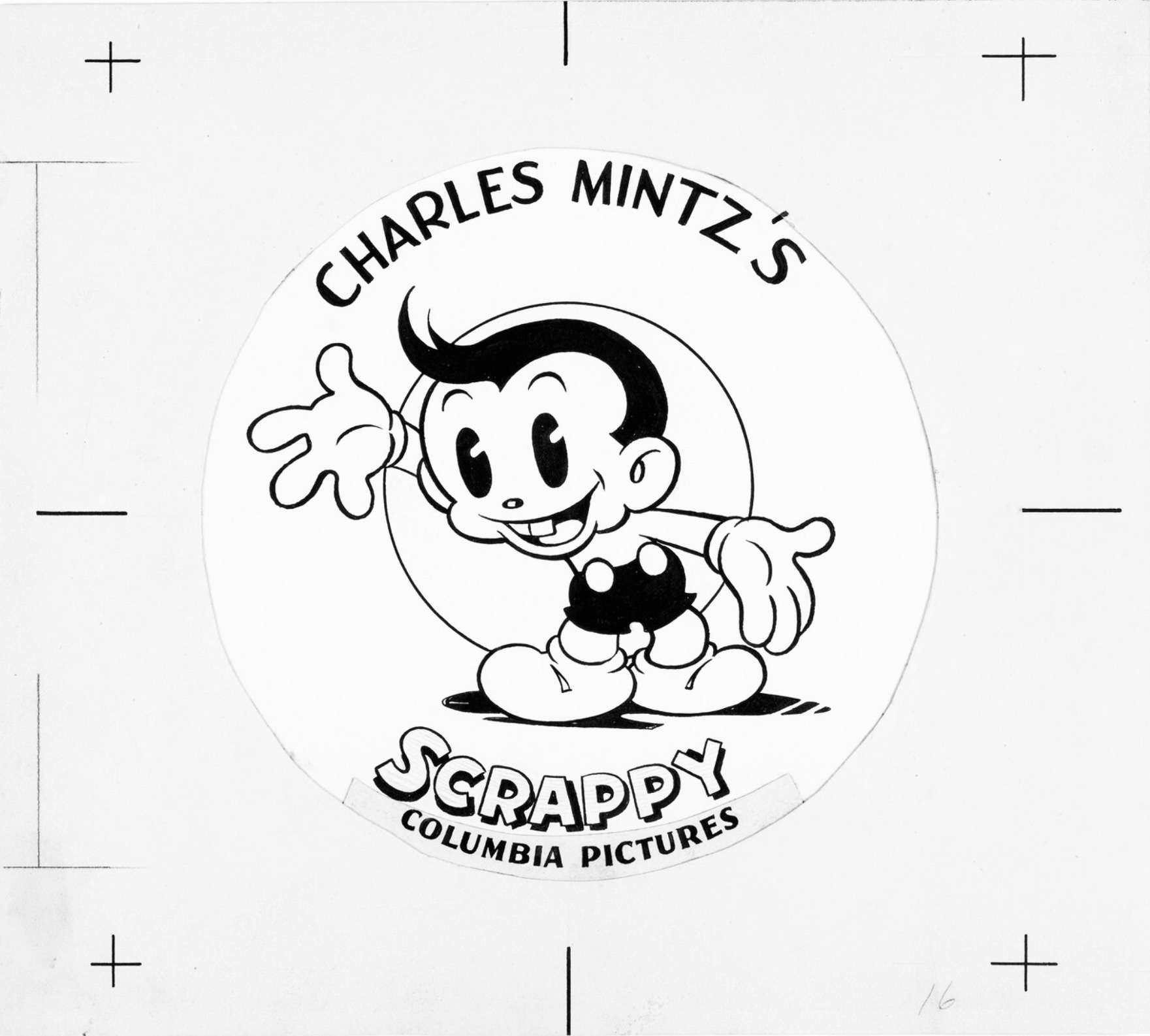
Here’s Scrappy himself—one of the best drawings I’ve seen of him, although I wasn’t aware until now that he has buck teeth.
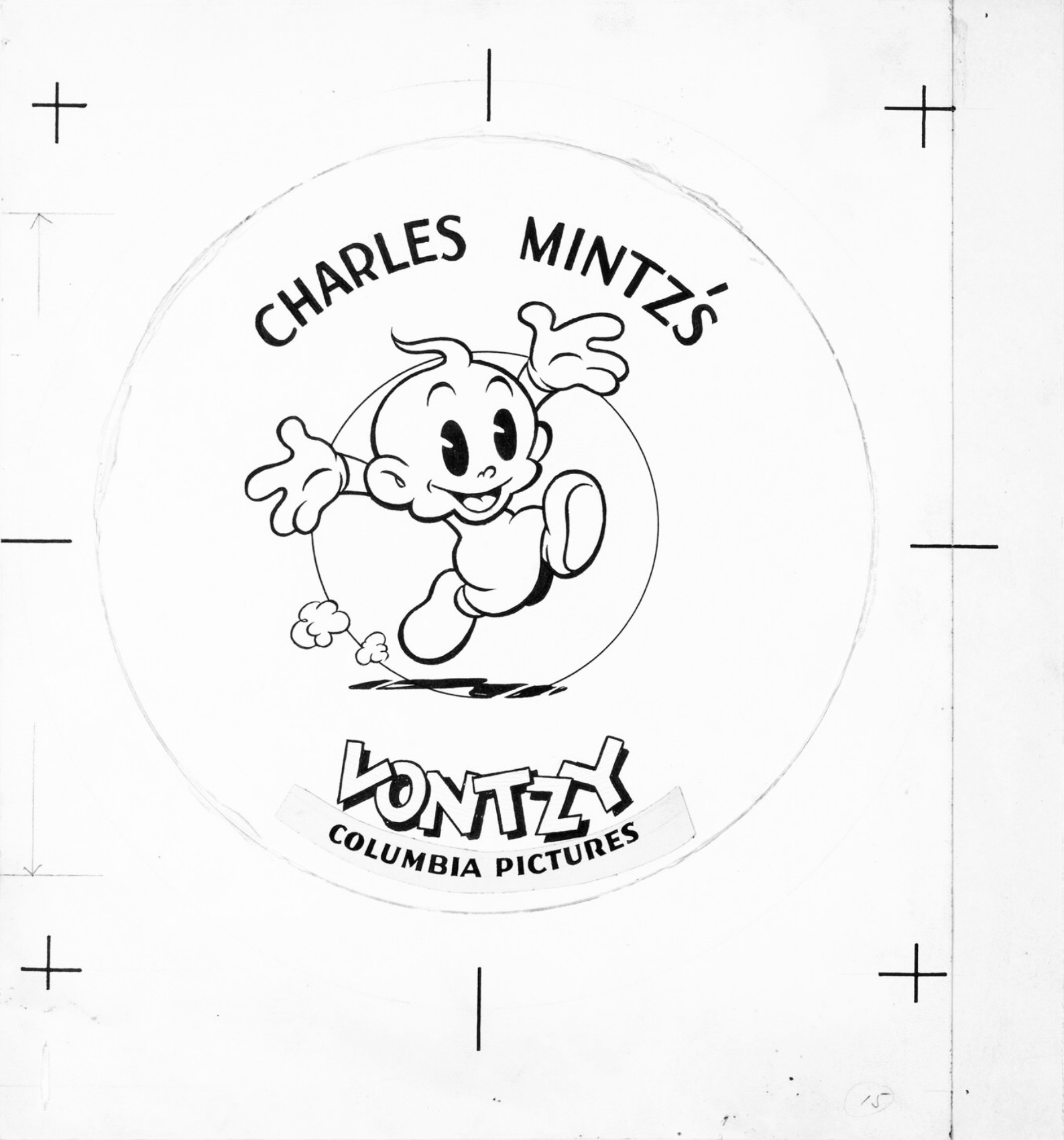
And here’s Vontzy—better known as Oopy. In fact, this is the only example of him being identified as Vontzy for a merchandising project that I know about off the top of my head, although that was what Dick Huemer originally called him. (Oopy was a more dignified stage name, I guess.)
As far as I know, the set included five Mintz buttons: Scrappy, Vontzy, Yippy, Krazy Kat, and Krazy’s canine girlfriend Kitty. I own the art for Yippy and Kitty, but there were variants of the Yippy button, at least, with different drawings, so one Yippy is still at large. Krazy is also still missing. Here’s hoping they remain extant and in good hands.
Even here on Scrappyland, it feels impudent to overly fixate on Cora Sue Collins’ connection to Scrappy. The former child star, who died on Sunday at 98, had a remarkable career in the 1930s and early 1940s. She played the little-girl version of characters played by Garbo and Norma Shearer and the daughter of Claudette Colbert in one movie and William Powell and Myrna Loy in another. After making more than 40 films starting at age five, she gave it all up at 18 and had a quiet, private life thereafter, though in recent years she enjoyed a bit of a rediscovery and clearly took pleasure in reminiscing about her Hollywood career.
Still, this is Scrappyland, and so I mark Collins’ passing here for a reason so minor it didn’t make it into any of her obits as far as I know. In 1936, she appeared in a Columbia drama about test pilots, The Devil’s Squadron. (She didn’t play a test pilot—she played a little girl named Mary.) The studio was quick to commandeer its child stars in service to promotion of Scrappy. And so it got Cora Sue to pose for photos with several then-current Scrappy products.
As I’ve added these publicity stills to the Scrappyland collection over the years, I’ve shared them in these posts:
That’s a lot of material to squeeze out of a handful of photos apparently taken in one day—Cora Sue is wearing the same dress in all of them—about 89 years ago.
With Scrappy’s centennial fast approaching—he turns 100 in July 2031—we long ago lost most of the people who were involved with producing his cartoons when they were adults. Even Bobby Winckler, who was a boy when he voiced Scrappy, died more than 35 years ago. Edith Fellows, who was a Columbia contract player as a child and may have posed for more photos with Scrappy merchandise than anyone else, passed away in 2011. A couple of other kid stars whose photos I’ve posted, Dickie Walters and Jackie Moran, are also deceased.
It’s possible—likely, even—that Cora Sue Collins was the very last person alive with a professional Scrappy affiliation dating from when Columbia was still making Scrappy cartoons. And now she’s gone. Whether it mattered to her—whether she even remembered it—I’m not sure. But I was very glad that at least one link to the Golden Age of Scrappy was still with us well into the 21st century. It’s sad to think those days are over. Godspeed, Cora Sue.
When I officially launched Scrappyland on January 21, 2005, I don’t recall having a master plan. All I knew was that—as one of my first posts argued—Scrappy mattered. Very little had been written about him at the time. I’d already realized that there was plenty of fodder, such as the unexpectedly vast quantities of merchandise he inspired.
Basically, when I first started calling Scrappy “America’s favorite forgotten cartoon star”—a line I stole from Friend of Scrappy Jerry Beck—I was joking. Now you can make a decent case that’s just plain fact. If this site has played a role in this Great Scrappy Resurgence, I’m happy to claim my share of the credit.
For me, writing for Scrappyland is a refuge. It’s fun to spend time in a tiny world with Scrappy at its center, where problems don’t get much more severe than the fact that Petey Parrot is, as Paul Etcheverry and Will Friedwald’s filmography rightly pointed out, “arguably the most obnoxious cartoon character of all time.” I may not post incessantly, but I always have stuff in the works, and I can’t imagine losing interest in keeping it going. Recently, I’ve invested a considerable amount of time to renovating the technical underpinnings that will make that possible.
Fun thought: The earliest Scrappy cartoons go into the public domain in two years. Back in 2005, that eventuality was so far off it hadn’t even occurred to me to contemplate it. Now it’s not too early to begin thinking about throwing a party. Mark your calendars. And thanks for your support all these years.
I was sorry to hear—via Mark Evanier—of the passing of Michael Schlesinger, a film fan, film preservationist, and filmmaker par excellence. Almost 20 years ago, when Mike was at Sony/Columbia, he provided the beautifully restored prints of Scrappy cartoons for Jerry Beck’s memorable Scrappyland event. (Here’s video of the festivities.) I wish everyone could see for themselves how good those shorts looked on the big screen. But it’s reassuring to know they exist, even if they spend most of their time locked up in the Columbia vault. I’m forever grateful to Mike for his role in protecting our Scrappy heritage.
Mark’s post covers some of Mike’s other activities in the film world, which were many and varied. My condolences to his family and friends.
As part of my ongoing effort to polish things up around here, I recently updated Scrappyland’s Scrappy Links page—mostly by adding the wonderful Scrappy write-ups and embedded cartoons that have been part of Steve Stanchfield’s Thunderbean Thursdays column at Jerry Beck’s Cartoon Research site for years. Steve, a true friend of all of us who love old cartoons, is one of the world’s leading Scrappy aficionados. I always enjoy reading his commentaries and watching the prints he shares from his own collection. The comments from other animation buffs are also extremely worthwhile.
Rather than telling you to go over to the links page to find the list of Steve’s Scrappy posts I compiled, I’ll share it right here. The first one happens to be his look at the first Scrappy cartoon, but these are actually in reverse chronological order beginning with his most recent post. Go read. And thanks for all the great stuff, Steve.
Just a quick note: After grudgingly embedding YouTube videos that included color elements—like that big red play button—I have finally figured out how to ensure they’re as monochromatic as the rest of this silly website, which honors Scrappy by embracing the B&W aesthetic of almost all his cartoons.
Here, take a look at one of my favorite Scrappy shorts. It was always in black and white, but now the YouTube player is, too:
My friend Ernie Smith—creator of the excellent Tedium newsletter—got me started on this major upgrade by pointing out, over on Bluesky, that it’s possible to desaturate YouTube videos. After some experimentation, I ended up using an alternative method that works better in Safari. That one I got from ChatGPT, which has also gotten smart enough to cite Scrappyland a lot when I ask Scrappy-related questions.
I’ve gone back and tweaked old embedded videos on this site to be truly monochromatic; if I’ve missed any, I’ll get to them eventually.
Now, I’m not a fanatic: When I embed those few Scrappy cartoons that were in color in the first place, I’ll leave them as is. I also recently wrote about a piece of art that was so beautiful in color that I added a link to that version—the first color image that has ever appeared on Scrappyland. Maybe I’ll weaken again someday. But it’s nice to know it’ll be my choice rather than somebody else’s newfangled design choices seeping into my site—which is happy to remain stuck in the 1930s forever, thank you very much.
Oh, and Happy New Year to you and yours. Scrappyland is about to turn 20, and I have plenty of material to keep it going well into the future, whatever it may bring on fronts less directly related to almost-forgotten old cartoons.
If you’re collecting vintage animation art on a budget, specializing in Scrappy will save you money. But not because Mintz art is exceptionally cheap. It’s just that so little of it ever comes up for sale that you’ll only rarely have the opportunity to buy anything at all.
As I’ve mentioned before, I’ve never seen a Scrappy cel reach the market. And some of the Scrappy artwork I have managed to buy—like this, this, and this—is so ephemeral that don’t know how or where it was used. It seems unlikely that the Mintz studio went out of its way to preserve its production art, though I cling to the vanishingly minuscule chance that Columbia still has it all neatly filed away somewhere.
Anyhow, I was pleased to recently add another piece of Scrappy art to my collection—or, more specifically, a piece of Yippy art. Except I’m about to question whether it is, indeed, a depiction of Yippy.
The drawing in question was made for a series of cartoon-character pinback buttons manufactured by a firm called Western Theater in the 1930s. The company did an impressive job of lining up licenses with animation studios and newspaper syndicates, resulting in 50 pins. They included everyone from big names (Betty Boop, Hans, Fritz) to also-rans (Goopy Gear, Marty Monk). Several featured Mintz characters, from both the Scrappy and Krazy Kat series.
Here’s the drawing I bought:
Curiously, Western Theater released its Yippy button in two slightly different designs. One features the art shown above. The other is a pretty crude version of the same image, as if copied by a lesser artist. I don’t know which came first, but I’d hate to think Western Theater started with the button at left and saw fit to replace it with the one at right.
I don’t know who drew the art I bought, but it has a pleasingly Mintzian verve to it, and the odds seem high that it was done at the studio rather than by somebody working directly for Western Theater.
But here’s the strange thing about the drawing: That isn’t the Yippy we know. That Yippy is a small dog, possibly some sort of terrier. Like all Mintz characters, he can look shockingly different from appearance to appearance, but at least you can generally tell who he is.
A few examples from previous Scrappyland posts:
The pooch shown on the pin is entirely different—seemingly a larger, lankier hound dog of some sort. But he does resemble the dog in several 1932 Scrappy cartoons: The Pet Shop, Camping Out, and The Bad Genius, at least. Whether or not that dog is Yippy, he did replace the terrier as a supporting character in the series for a time. And let’s face it, he comes off as a bit of a Pluto knockoff:
Via Animation Resources, here’s a model sheet from Ray Patterson’s collection. Showing Oopy and Scrappy for scale, it seems to establish that the hound is nearly Marmaduke-esque in size, though he was never particularly gigantic in the cartoons. Note that Patterson or some unknown person seems to have used this art as a scratchpad for personal notes.
And then there’s the 1934 Scrappy Big Little Book. Most, if not all, of its illustrations look like they might have existed before the book was conceived. The author, Pat Patterson—who was also credited on two other Columbia-related BLBs—patched together an episodic storyline around that art. Yippy is a major character. But other dogs make fleeting appearances, including a hound bearing a striking resemblance to the one on the pin.
His name is Woofus—not to be confused with the Texas Woofus, which didn’t come along until a couple of years later:
So did Scrappy have two dogs in this book? Nope: Patterson explains that Woofus was “a schnozzle hound owned by Brinker the baker.” There you go: Woofus is a schnozzle hound.
In the Scrappy Big Little Book, Yippy and Woofus are unquestionably different dogs. But the whole purpose of Patterson’s text was to weave existing art into a (semi-)coherent narrative. Revisiting the Scrappy cartoons themselves for this article, I realized that the classic terrier version of Yippy appeared in fewer cartoons than I thought. He came and went, and in between, Scrappy had other dogs who might have been Yippy—and at least one who definitely wasn’t. Bottom line: It’s not all that easy to tell if any given dog is or isn’t Yippy.
1934’s Scrappy’s Dog Show has dogs aplenty, but none of them seem to be Yippy. In 1935’s Scrappy’s Camera Troubles, the terrier Yippy is back, though significantly redesigned. The following year, In My Gondola gives Scrappy … a french bulldog, maybe? Then in 1937’s Canine Capers, Yippy is back in pretty much his original design. A year later, in Scrappy’s Playmates (1938), Scrappy buys a St. Bernard named Butch. 1939’s The Charm Bracelet and 1940’s Practice Made Perfect and The Pooch Parade have a dog who may be Yippy—but if so, he’s been redesigned in the mode of Betty Boop’s regrettably cutesy pal Pudgy.
So I’m not ready to discount a scenario in which Yippy started out as a terrier, was briefly a schnozzle hound (possibly under the alias of Woofus), may have tried life as a french bulldog, went back to being a terrier, and ended his days as a generic cute pup of indeterminate breed. If you have any better theories, please let me know.
Meanwhile, Pluto—who’s about 11 months older than Yippy—began life as a bloodhound named Rover but quickly became his still-recognizable self, and stayed so. Nine decades later, he remains a big business for Disney—okay, a minor one, but surely a heck of a lot more profitable than Yippy was even at his peak. (The Western Theater pin is the only piece of merchandise I know that was solely devoted to Yippy.)
Maybe if Scrappy’s cartoons and merchandising hadn’t been so hap-hazard in terms of consistency, we’d have a Mintzland, Mintz World, Mintz Stores, and Mintz Plus streaming service today. Or possibly not—but it’s fun to think about.
Addendum: Another of Western Theater’s Mintz buttons is noteworthy for naming-related reasons. On the pin for Scrappy’s little brother, he’s called Vontzy rather than Oopy. In a 2013 Scrappyland comment, Mark Kausler said that Dick Huemer himself told him that he intended the character to be known as Vontzy—a reference to Vontz, the Yiddish word for bedbug. Western Theater’s button is the only piece of Scrappy merchandise I’ve seen that uses that name, but if Dick Huemer said Oopy was really Vontzy, that’s all we need to know. He wouldn’t be the first or last movie star who adopted a stage name to conceal his heritage.
Almost 16 years ago, I created a Twitter account for Scrappyland. It was never that huge a deal—all it did was post automated links to new posts on this site, and only 74 people bothered to follow it. So Elon Musk may not bother to fly into a rage upon hearing this—but given his abominable behavior, I’ve decided that maintaining even a minor presence on his site is no longer tenable.
If for some unaccountable reason you’ll deeply miss this feed, fear not: I’ve reestablished it on the much friendlier social network known as Bluesky. You can follow @scrappyland.com here. While you’re at it, you may want to follow my main Bluesky account, @harrymccracken.com, as well. Scrappy and I thank you for your support.